


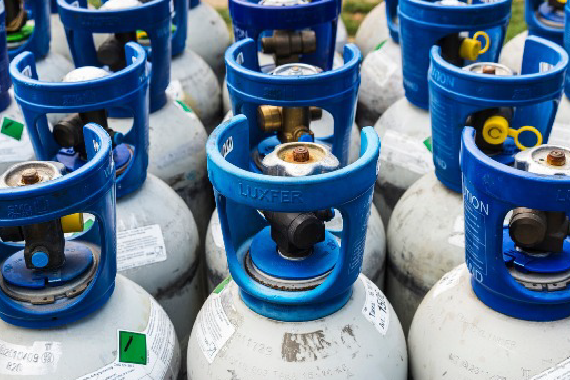
In early December 2025, Canadian authorities issued an alert after discovering counterfeit R410A cylinders containing dangerous mixtures of R32 and even R40 (methyl chloride) a highly reactive gas that can cause explosions when it comes into contact with aluminium components.
For importers, distributors and large users of refrigerants, this is more than a technical issue. It is a clear example of how tightening F-gas regulation and quota pressure create fertile ground for counterfeit products, and why supply chain control has become a strategic business concern rather than just a purchasing detail.
According to Environment and Climate Change Canada (ECCC), the counterfeit cylinders resemble R410A, but testing showed they contain a mixture of R32 and R40 (methyl chloride or chloromethane), instead of the expected R410A blend.
Under the AHRI 700 standard, the correct R410A blend is a half-and-half mixture of the flammable refrigerants R32 and R125. The presence of R125 suppresses flammability and allows R410A to be classified as non-flammable.
From a risk perspective, the problem is R40:
R40 in counterfeit refrigerants is not a new phenomenon. In 2011 and 2012, blends of R40 and non-flammable R22, falsely labelled and sold as R134a, were linked to a series of explosions and several deaths, particularly in the refrigerated container sector. Hundreds of containers were quarantined and thousands of reefers were grounded worldwide while shipping lines and authorities investigated the contamination problem. That history shows that the Canadian R410A case is not an isolated event, but part of a recurring pattern: R40-based counterfeits tend to appear wherever economic pressure on refrigerants creates an opportunity for criminal blending.
Canada’s recent alert comes at a time when high GWP HFCs such as R410A are under intense regulatory pressure worldwide and the supply of legitimate product is increasingly restricted and controlled. In the European Union, Regulation (EU) 2024/573 sharply tightens the HFC phase down and shifts from a gradual reduction to an explicit phase out by 2050, with steeper cuts from 2025 onwards. Quotas now act as a gatekeeper to the market for both bulk HFCs and pre-charged equipment.
The business logic behind the rise of counterfeits is straightforward:
That combination of high demand, constrained legal supply and rising prices creates exactly the conditions in which counterfeit product becomes attractive to unscrupulous traders. The Canadian case is therefore not an anomaly, but a warning signal of a broader structural risk in the refrigerant market.
The Canadian bulletin offers practical detection and prevention steps. Combined with lessons from past counterfeit cases, these can be translated into a clear business playbook for importers, distributors, and large users.
Procurement, warehouse and service personnel all see different parts of the risk. Train them to recognise:
Establish a clear internal procedure for quarantining and reporting suspected counterfeit refrigerant, including who to notify internally and which authorities or partners to contact.
AFS Cooling is positioned precisely at the intersection of F-gas regulation, quota management, and refrigerant procurement.
In practical terms, that means we can help you:
For businesses, the right response goes beyond swapping one supplier for another. It is about embedding compliance, traceability and quality control into your refrigerant strategy, especially as F-gas rules and quotas become more restrictive and enforcement more assertive.
If you want to assess how exposed your current refrigerant supply chain is, or explore how to integrate secure sourcing, quota management and quality control into one coherent strategy, the AFS Cooling team is ready to support you.

