


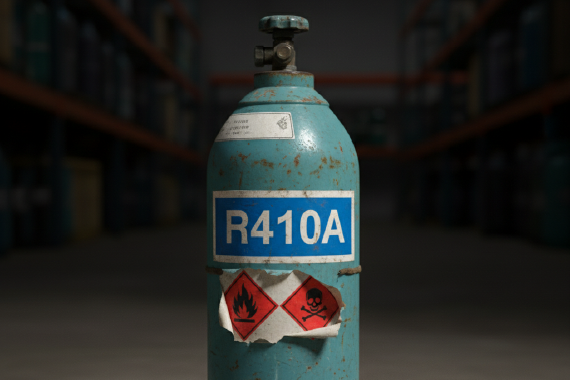
In early December 2025, Canadian authorities issued a public safety alert after uncovering counterfeit cylinders falsely labelled as R410A that contained dangerous mixtures of R32 and R40 (methyl chloride). The discovery triggered immediate warnings across the HVACR sector, not only because of the severe safety risks involved, but because it exposed a deeper structural vulnerability within the global refrigerant market.
At first glance, counterfeit refrigerant might appear to be a niche regulatory or technical issue. In reality, it reflects a systemic shift in how refrigerants are produced, traded, and regulated. As high-global warming potential (GWP) gases are phased down across major markets, supply is tightening, prices are rising, and procurement complexity is increasing. These pressures are reshaping the economics of refrigerant supply chains, creating fertile ground for criminal activity while simultaneously raising the compliance stakes for legitimate market participants.
For manufacturers, contractors, distributors, and large system owners, counterfeit refrigerant is no longer just a quality-control risk. It is becoming a strategic business concern with implications for safety, legal liability, operational continuity, and corporate reputation. Understanding why this risk is accelerating, and how it can be effectively managed, is now a commercial necessity.
According to Environment and Climate Change Canada (ECCC), the counterfeit cylinders were presented as R410A but contained a mixture of R32 and R40, rather than the standard R32 and R125 blend defined under AHRI 700 specifications. The absence of R125 is critical. In legitimate R410A, R125 acts as a flame suppressant, allowing the blend to be classified as non-flammable. Without it, the mixture becomes significantly more hazardous.
R40, or methyl chloride, compounds the danger. While inexpensive and relatively easy to source, R40 is:
• Highly flammable, with explosive potential under normal service conditions
• Toxic, with neurological and reproductive health effects at elevated concentrations
• Chemically reactive with aluminium and certain plastics, materials widely used in HVAC equipment
When systems contaminated with R40 are opened during servicing, exposure to air and moisture can trigger aggressive chemical reactions, producing corrosive acids and, in extreme cases, explosive compounds. Historically, such contamination has been linked to multiple fatalities and widespread equipment failures.
This is not a new phenomenon. In 2011 and 2012, counterfeit blends containing R40 were falsely sold as R134a, leading to explosions aboard refrigerated shipping containers and the grounding of thousands of reefers worldwide. That episode demonstrated that counterfeit refrigerant is not a theoretical risk. It is a proven cause of severe industrial accidents when market conditions allow it to proliferate.
What makes the 2025 Canadian case particularly significant is its timing. It arrives at a moment when regulatory pressure on refrigerants is reaching unprecedented levels globally.
The emergence of counterfeit R410A is directly linked to structural shifts in refrigerant regulation and market economics.
Under the EU’s revised F-gas Regulation (EU) 2024/573, the HFC phase-down accelerates sharply from 2025 onward, transitioning from gradual reduction to a long-term phase-out trajectory toward 2050. The most critical inflection point arrives in 2027, when permitted HFC quota volumes are scheduled to fall by roughly 50% compared with current levels.
This regulatory tightening is already reshaping supply:
• Total F-gas volumes placed on the EU market are now approximately 45% lower than in 2015, measured in CO₂-equivalent terms.
• EU HFC production has declined by more than 70% in physical tonnes relative to historical baselines.
• Bulk imports of high-GWP refrigerants are shrinking, while administrative controls and documentation requirements are intensifying.
At the same time, installed base realities are lagging behind regulatory ambition. Millions of air conditioning, heat pump, and refrigeration systems worldwide still rely on R410A for servicing. Although new equipment is shifting toward lower-GWP alternatives, replacement cycles for HVAC systems typically span 15 to 25 years, ensuring sustained demand for legacy refrigerants well into the 2030s.
This creates a fundamental imbalance:
• Demand remains structurally high.
• Legal supply is shrinking and increasingly regulated.
• Prices are rising, and market volatility is increasing.
These conditions are textbook enablers for counterfeit activity. When legitimate supply becomes scarce, expensive, and administratively complex, illicit alternatives gain commercial appeal. The economics are straightforward: blending R40 into counterfeit refrigerants dramatically reduces production costs, allowing illegal traders to undercut market pricing while maintaining significant margins.
As enforcement intensity varies widely across jurisdictions, international supply chains become particularly vulnerable. Refrigerant flows often cross multiple borders before reaching end users, creating opportunities for counterfeit material to enter legitimate distribution networks unnoticed.
Historically, refrigerant quality was viewed as an operational detail managed by procurement or technical teams. That perspective is no longer sufficient. Counterfeit refrigerants expose businesses to a multi-layered risk profile that spans safety, compliance, finance, and reputation.
The presence of toxic and flammable substances in HVAC systems introduces immediate risks to technicians, occupants, and surrounding infrastructure. In the event of accidents, businesses face:
• Workplace injury claims
• Regulatory investigations
• Criminal liability in cases of negligence
• Civil lawsuits for damages
As awareness of counterfeit risk grows, legal standards for “due diligence” are likely to rise. Companies unable to demonstrate robust sourcing and verification procedures may struggle to defend themselves in court.
Contaminated refrigerant can cause catastrophic damage to compressors, heat exchangers, and pipework. Acid formation, corrosion, and explosive reactions may necessitate full system replacement rather than routine repair.
For data centres, hospitals, food logistics facilities, and industrial refrigeration operators, this translates directly into:
• Unplanned downtime
• Loss of product
• Service disruption penalties
• Emergency capital expenditure
F-gas regulation enforcement is tightening across Europe, North America, and Asia-Pacific. Possession, handling, or installation of non-compliant refrigerants can result in:
• Heavy financial penalties
• Quota suspension or revocation
• Import licence restrictions
• Loss of operational certifications
For multinational organisations, compliance failures in one jurisdiction increasingly carry cross-border implications.
As sustainability reporting and ESG disclosures become mandatory under frameworks such as the EU’s Corporate Sustainability Reporting Directive (CSRD), refrigerant management is emerging as a material environmental metric. Involvement, even inadvertently, in counterfeit refrigerant scandals can undermine corporate sustainability narratives and investor confidence.
The Canadian authorities’ guidance, combined with lessons from prior counterfeit incidents, points toward a clear set of best-practice principles.
Procurement must shift from price-led purchasing to compliance-led sourcing. This includes:
• Working exclusively with authorised distributors and quota-holding suppliers
• Verifying regulatory compliance documentation for each transaction
• Avoiding opportunistic purchases driven solely by short-term cost advantages
Significantly below-market pricing, unusual payment terms, or inconsistent delivery channels should be treated as red flags, not commercial opportunities.
Operational teams should implement rigorous inspection protocols:
• Visual examination of cylinders for branding inconsistencies, spelling errors, and irregular labelling
• Verification of valve types, cylinder colours, and packaging specifications
• Cross-checking batch numbers and serial codes with manufacturers
For high-risk applications, portable refrigerant analysers can provide rapid confirmation of gas composition before systems are charged or recovered.
Risk mitigation depends on human vigilance. Procurement, warehouse, and service personnel must be trained to recognise early warning signs and empowered to quarantine suspicious stock without commercial pressure.
Clear internal escalation procedures should be established, defining who to notify, how to isolate product, and when to involve regulatory authorities.
Despite technological progress and regulatory ambition, the refrigerant transition remains structurally constrained by installed equipment realities. The pace of system replacement cannot match the speed of regulatory phase-downs. This ensures that demand for high-GWP refrigerants will remain elevated even as legal supply tightens further.
Additionally, enforcement capacity varies widely between jurisdictions. Criminal networks exploit regulatory asymmetries, routing counterfeit product through weaker control environments before injecting it into tightly regulated markets.
As quotas compress further after 2027, these pressures will intensify. Without proactive intervention, counterfeit risk is likely to expand rather than stabilise.
AFS Cooling operates at the intersection of regulatory compliance, quota management, and refrigerant procurement, enabling clients to navigate the refrigerant transition with confidence and control.
AFS Cooling provides access to fully compliant refrigerant supply chains, anchored in long-term partnerships with legitimate producers and quota holders. This ensures:
• Regulatory conformity across EU and international markets
• Stable supply availability despite tightening quotas
• Reduced exposure to volatile spot markets and illicit trade
Beyond physical supply, AFS Cooling supports clients with:
• Quota optimisation strategies
• Regulatory exposure mapping
• Market entry and import compliance planning
• Medium-term refrigerant transition roadmaps
This allows businesses to anticipate regulatory thresholds rather than react to supply crises.
AFS Cooling assists in designing auditable refrigerant procurement processes, embedding compliance, traceability, and quality assurance into purchasing workflows. This supports:
• Internal governance standards
• OEM requirements
• External regulatory audits
Drawing on real-world enforcement cases, AFS Cooling helps clients implement:
• Cylinder verification protocols
• Supplier due-diligence frameworks
• Staff training programmes
• Incident response procedures
Together, these measures reduce both operational and legal exposure.
The refrigerant transition is fundamentally reshaping HVACR economics. What was once a commoditised procurement category is rapidly becoming a strategic risk domain.
As counterfeit incidents rise, businesses that rely on opportunistic sourcing and short-term price advantages expose themselves to escalating safety, legal, and operational risks. In contrast, those that invest in compliance-driven procurement, secure sourcing strategies, and regulatory intelligence are better positioned to protect assets, ensure service continuity, and maintain commercial credibility.
In this evolving environment, compliance is no longer merely a regulatory obligation. It is becoming a defining element of competitive advantage.
If your organisation would benefit from a strategic assessment of refrigerant sourcing, quota exposure, or counterfeit risk management, AFS Cooling stands ready to support you.

