


For owners and operators of commercial and industrial cooling systems in the United States, the regulatory landscape shifted decisively on 1 January 2026. The United States Environmental Protection Agency implemented its stringent HFC Leak Repair and Management Rule, commonly referred to as the HFC Management Rule, under the authority of the American Innovation and Manufacturing Act. This comprehensive framework imposes demanding emission reduction and reclamation requirements that fundamentally alter how businesses manage their cooling assets.
At the heart of this compliance landscape is the strict operational timeline governing leak detection and repair. This regulation introduces clear administrative boundaries that can rapidly escalate into severe operational liabilities if a facility lacks a secure, resilient chemical supply chain.
The HFC Management Rule, codified under 40 CFR Section 84.106, applies directly to any refrigerant-containing appliance with a full charge of 15 pounds or more. Under this strict structure, system operators are required to calculate the leak rate of an appliance every single time a hydrofluorocarbon refrigerant is added to the system.
If this calculation reveals that the system has exceeded the allowable leak rate threshold, which is categorised specifically by equipment type, a legally binding repair timeline is immediately triggered. System operators are given a maximum of 30 days from the date of the exceedance to conduct a successful, verified repair of the leak.
The consequences of failing to complete a verified repair within this 30-day window are severe. If a facility manager cannot verify the repair within the mandatory timeline, the owner must draft and implement a formal retrofit or retirement plan. This plan compels the operator to fully retire or retrofit the non-compliant system within one year. For high-capacity industrial installations, this can result in premature capital expenditures and devastating operational downtime.
Furthermore, the rule mandates the installation of automatic leak detection systems on all new and existing systems in the industrial process and commercial refrigeration sectors with a charge size of 1,500 pounds or more. While new installations had to comply by 1 January 2026, existing systems face a hard compliance deadline of 1 January 2027.
The rigid 30-day compliance window is designed to protect the environment, but it collides directly with challenging supply chain bottlenecks in the physical market. As the industry transitions away from legacy high-GWP refrigerants, such as R-410A (which contains R-125) and R-404A, towards more sustainable, lower-GWP alternatives, a major operational hurdle has emerged: the availability of mildly flammable A2L refrigerants in aftermarket cylinders.
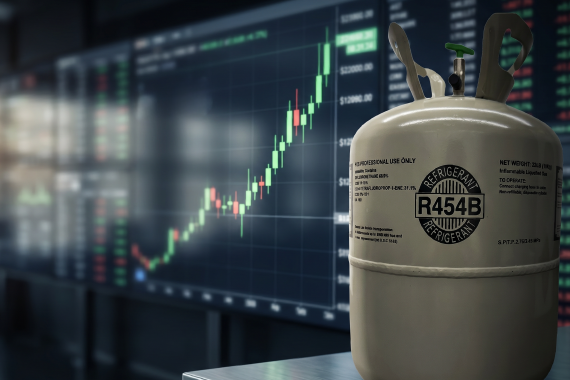
Independent industry analytics reveal a critical shortage of R-454B in aftermarket cylinders. While pre-charged cooling equipment is increasingly available from manufacturers, sourcing the physical refrigerant gas in portable cylinders for field service has become exceptionally difficult. Due to aggressive demand growth and severe cylinder supply constraints, the price of R-454B has spiked to approximately 340 percent above baseline levels.
For a facility manager managing a ticking 30-day compliance clock, this cylinder shortage is a direct threat. If a system utilizing R-454B develops a leak, a technician cannot complete the mandatory leak repair without the appropriate service gas. The compliance clock continues to run regardless of local cylinder shortages, potentially forcing desperate, non-compliant substitutions or triggering an unwanted mandatory system retirement.
This risk is compounded by broader supply chain friction. Essential components, including variable frequency drives, customized heat exchangers, and specialized compressors, are facing extended lead times due to maritime transport delays. While the EPA provides narrow regulatory extensions for parts or refrigerant unavailability, securing these exemptions requires meticulous documentation and proactive coordination.
Navigating the intersection of strict U.S. leak repair clocks and global logistics instability requires specialized compliance and procurement strategies. Operating as a trusted global refrigerant partner, AFS Cooling provides the exact administrative and logistical support required to insulate facility operators from compliance risks.
AFS Cooling works directly with facility owners and site contractors to implement comprehensive compliance playbooks designed specifically around 40 CFR Section 84.106. This includes providing custom documentation templates, maintaining audit-ready records, and establishing a clear, actionable escalation path to legally request regulatory extensions when parts or gases are delayed.
To directly address the critical shortage of A2L cylinders and the structural scarcity of traditional HFCs like R-410A, AFS Cooling leverages a robust global supplier network. By sourcing virgin, reclaimed, and recycled gases globally, the firm enables clients to secure critical inventory buffers before peak cooling seasons. Securing a dedicated replenishment service level agreement ensures that when a leak is detected, the required service gas is already on-site, allowing technicians to stop the 30-day clock immediately and protect the longevity of the cooling asset.

